Have you ever looked at Cortex M4 instruction set ? There is a particular one that does not seem like much but can do some magic !
I’m talking about SEL intrinsic and this article will show one of its possible usage in a Min/Max detection algorithm.
Basic C Min/Max detection
Let’s start with a C implementation. Same logic can be applied on both 8- and 16-bits buffers.
C generic implementation
#ifdef DATA_8
typedef int8_t s_data_t;
typedef uint16_t u_pair_t;
#else //DATA_16
typedef int16_t s_data_t;
typedef uint32_t u_pair_t;
#endif

typedef union {
    struct {
      s_data_t min;
      s_data_t max;
    }fields;
    u_pair_t pair;
} MinMax_t;

MinMax_t SearchMinMax_C(s_data_t* pSrc, int32_t pSize)
{
    s_data_t data, min, max;
    MinMax_t out;

    data = *pSrc++;
    min = data;
    max = data;

    while (--pSize > 0)
    {
        data = *pSrc++;
        if (data < min)
        {
            min = data;
        }
        if (data > max)
        {
            max = data;
        }
    }

    out.fields.min = min;
    out.fields.max = max;

    return out;
}
This very straight-forward implementation is already pretty efficient thanks to Thumb-2 instruction IT (If-Then) that allows conditional execution and removes branches. Here si the detail of Keil compiler output (ARM Compiler V5.04.0.49 Evaluation).
8-bits Optimized compiler output (-O3 -Otime)
                                ; Bytes Cycles    Comment
SearchMinMaxC:                  ;   -     3       Function call
  LDRSB         r2,[r0],#0x01   ;   4     2       Load from post-incremented sample pointer and update it
  SUBS          r1,r1,#1        ;   2     1       Decrement loop counter
  MOV           r3,r2           ;   2     1       Copy loaded data to Max register
  CMP           r1,#0x00        ;   2     1       Test if we need to loop
  BLE           final           ;   2    1,3      Go through (1 cycle) or loop (3 cycles)
loop:
  LDRSB         r12,[r0],#0x01  ;   4     2       Load from post-incremented sample pointer and update it
  CMP           r3,r12          ;   2     1       Compare new sample to max
  IT            GT              ;   2     1       Execute following Move if new sample is bigger
  MOVGT         r3,r12          ;   2     1       Conditionally Store new sample in Max register
  CMP           r2,r12          ;   2     1       Compare new sample to min
  IT            LT              ;   2     1       Execute following Move if new sample is smaller
  MOVLT         r2,r12          ;   2     1       Conditionally Store new sample in Min register
  SUBS          r1,r1,#1        ;   2     1       Decrement loop counter
  BNE           loop            ;   2    3,1      Loop (3 cycles) or go through (1 cycle)
final:
  UXTB          r0,r3           ;   2     1       Keep only 8 lower bits of Max value and put them in return register
  BFI           r0,r2,#8,#8     ;   4     1       Put 8 lower bits of Min value in byte 1 of return register
  BX            lr              ;   2     3       Return

ROM : 40 bytes
Stack : 0 bytes
Cycles : 9 + 12 * (N - 2) + 10 + 5
16-bits Optimized compiler output (-O3 -Otime)
                                ; Bytes Cycles    Comment
SearchMinMaxC:                  ;   -     3       Function call
  LDRSH         r2,[r0],#0x02   ;   4     2       Load from post-incremented sample pointer and update it
  SUBS          r1,r1,#1        ;   2     1       Decrement loop counter
  MOV           r3,r2           ;   2     1       Copy loaded data to Max register
  CMP           r1,#0x00        ;   2     1       Test if we need to loop
  BLE           final           ;   2    1,3      Go through (1 cycle) or loop (3 cycles)
loop:
  LDRSH         r12,[r0],#0x02  ;   4     2       Load from post-incremented sample pointer and update it
  CMP           r3,r12          ;   2     1       Compare new sample to max
  IT            GT              ;   2     1       Execute following Move if new sample is bigger
  MOVGT         r3,r12          ;   2     1       Conditionally Store new sample in Max register
  CMP           r2,r12          ;   2     1       Compare new sample to min
  IT            LT              ;   2     1       Execute following Move if new sample is smaller
  MOVLT         r2,r12          ;   2     1       Conditionally Store new sample in Min register
  SUBS          r1,r1,#1        ;   2     1       Decrement loop counter
  BNE           loop            ;   2    3,1      Loop (3 cycles) or go through (1 cycle)
final:
  BFI           r0,r3,#0,#16    ;   4     1       Put 16 lower bits of Max value in return register low halfword
  BFI           r0,r2,#16,#16   ;   4     1       Put 16 lower bits of Min value in return register high halfword
  BX            lr              ;   2     3       Return

ROM : 42 bytes
Stack : 0 bytes
Cycles : 9 + 12 * (N - 2) + 10 + 5
Parallel instructions study
Now, let’s add some DSP magic in there !
SEL instruction independently selects bytes from one of two registers based on corresponding APSR GE bit:
/* Usage :*/
/* Asm */ SEL Rd, Rn, Rm
/*  C  */ Rd = __SEL(Rn, Rm);
/* Let's write a 32 bit register the following :
Rx = B3 | B2 | B1 | B0 where B3 is the MSByte and B0 the LSByte */
Rd.B3 = (GE[3] == 1) ? Rn.B3 : Rm.B3;
Rd.B2 = (GE[2] == 1) ? Rn.B2 : Rm.B2;
Rd.B1 = (GE[1] == 1) ? Rn.B1 : Rm.B1;
Rd.B0 = (GE[0] == 1) ? Rn.B0 : Rm.B0;
Both Signed parallel byte-wise subtraction (SSUB8) and Signed parallel halfword-wise subtraction (SSUB16) do update APSR.GE bits (for a complete list of instructions updating GE bits, see ARMv6 SIMD instruction intrinsics and APSR GE flags).
I will detail things on 16-bit data: if we consider one register holding two 16-bits samples (xk and xk+1) and one register holding two previous 16-bits maximum (maxeven and maxodd):
uint32_t max, data;
max = (maxodd << 16) | (maxeven);
data = (xk+1 << 16) | (xk);
Now we can parallel compare them by performing a parallel 16-bit subtraction, this will update GE bits as following:
(void)__SSUB16(max, data);
/* tmp1 = maxodd - xk+1 ; GE[3:2] = (tmp1 >= 0)? 0b11 : 0b00
 * tmp0 = maxeven - xk ; GE[1:0] = (tmp0 >= 0)? 0b11 : 0b00 */
Finally, we have only to keep maximum value on each halfword using SEL:
max = __SEL(max, data);
/* maxodd =  (GE[3:2] == 0b11)? maxodd  : xk+1
 * maxeven = (GE[1:0] == 0b00)? maxeven : xk */
For minimum detection, it’s almost the same thing :
uint32_t min, data;
min = (minodd << 16) | (mineven);
data = (xk+1 << 16) | (xk);
(void)__SSUB16(data, min);
/* tmp1 = xk+1 - minodd  ; GE[3:2] = (tmp1 >= 0)? 0b11 : 0b00
 * tmp0 = xk   - mineven ; GE[1:0] = (tmp0 >= 0)? 0b11 : 0b00 */

min = __SEL(min, data);
/* minodd =  (GE[3:2] == 0b11)? minodd  : xk+1
 * mineven = (GE[1:0] == 0b00)? mineven : xk */
16-bits DSP implementation
Using previous logic to implement same Min/Max detection algorithm, we need to unroll the loop to perform 32-bit memory accesses. We also need to extract a single max and min value: I chose to do this outside the loop.
My 16-bit implementation is :
Implementation for 16-bits buffers
/* Using CMSIS DSP Library header for compiler abstraction */
#include "arm_math.h"

uint32_t SearchMinMax16_DSP(int16_t* pSrc, int32_t pSize)
{
    uint32_t data, min, max;
    int16_t data16;

    /* max variable will hold two max : one on each 16-bits half
     * same thing for min
     */

    /* Load two first samples in one 32-bit access */
    data = *__SIMD32(pSrc)++;
    /* Initialize Min and Max to these first samples */
    min = data;
    max = data;
    /* decrement sample count */
    pSize-=2;

    /* Loop as long as there remains at least two samples */
    while (pSize > 1)
    {
        /* Load next two samples in a single access */
        data = *__SIMD32(pSrc)++;
        /* Parallel comparison of max and new samples */
        (void)__SSUB16(max, data);
        /* Select max on each 16-bits half */
        max = __SEL(max, data);
        /* Parallel comparison of new samples and min */
        (void)__SSUB16(data, min);
        /* Select min on each 16-bits half */
        min = __SEL(min, data);

        pSize-=2;
    }
    /* Now we have maximum on even samples on low halfword of max
     * and maximum on odd samples on high halfword */
    /* look for max between halfwords 1 & 0 by comparing on low halfword */
    (void)__SSUB16(max, max >> 16);
    /* Select max on low 16-bits */
    max = __SEL(max, max >> 16);

    /* look for min between halfwords 1 & 0 by comparing on low halfword */
    (void)__SSUB16(min >> 16, min);
    /* Select min on low 16-bits */
    min = __SEL(min, min >> 16);

    /* Test if odd number of samples */
    if (pSize > 0)
    {
        data16 = *pSrc;
        /* look for max between on low halfwords */
        (void)__SSUB16(max, data16);
        /* Select max on low 16-bits */
        max = __SEL(max, data16);

        /* look for min on low halfword */
        (void)__SSUB16(data16, min);
        /* Select min on low 16-bits */
        min = __SEL(min, data16);
    }

    /* Pack result : Min on Low halfword, Max on High halfword */
    return __PKHBT(min, max, 16); /* PKHBT documentation */
}
This implementation leads to following assembly listing (with IAR 7.30.4.8187 evaluation compiler but we would have similar output with Keil):
DSP 16 Optimized compiler output (-Oh)
                                ; Bytes Cycles    Comment
SearchMinMax16_DSP:             ;   -     3       Function call
  PUSH      {r4, r5}            ;   2     3       Backup two registers
  LDR       r2, [r0], #0x4      ;   4     2       Load 2 samples and post-increment
  SUBS      r1, r1, #2          ;   2     1       Decrement loop counter
  CMP       r1, #1              ;   2     1       Test if we need to loop
  MOV       r3, r2              ;   2     1       Copy loaded data to Min register
  MOV       r4, r2              ;   2     1       Copy loaded data to Max register
  BLT       final               ;   2    1,3      Go through (1 cycle) or loop (3 cycles)
loop:
  LDR       r2, [r0], #0x4      ;   4     2       Load next 2 samples and post-increment
  SSUB16    r5, r4, r2          ;   4     1       Parallel compare Max to new samples
                                ;                 GE[3:2]=((MaxH - SampleH) >= 0)
                                ;                 GE[1:0]=((MaxL - SampleL) >= 0)
  SEL       r4, r4, r2          ;   4     1       Keep Max on each halfword
  SUBS      r1, r1, #2          ;   2     1       Decrement loop counter
  SSUB16    r5, r2, r3          ;   4     1       Parallel compare new samples to Min
                                ;                 GE[3:2]=((SampleH - MinH) >= 0)
                                ;                 GE[1:0]=((SampleL - MinL) >= 0)
  CMP       r1, #2              ;   2     1       Test remaining count
  SEL       r3, r3, r2          ;   4     1       Keep Min on each halfword
  BGE       loop                ;   2    3,1      Loop (3 cycles) or go through (1 cycle)
final:
  LSRS      r2, r4, #16         ;   2     1       Put MaxH on low halfword
  SSUB16    r5, r4, r2          ;   4     1       Compare MaxL to MaxH
                                ;                 GE[1:0]=((MaxL - MaxH) >= 0)
  SEL       r2, r4, r2          ;   4     1       Keep Max on low halfword
  LSRS      r4, r3, #16         ;   2     1       Put MinH on low halfword
  SSUB16    r5, r4, r3          ;   4     1       Compare MinL to MinH
                                ;                 GE[1:0]=((MinL - MinH) >= 0)
  CMP       r1, #1              ;   2     1       Test if sample count was odd
  SEL       r3, r3, r4          ;   4     1       Keep Min on low halfword
  BLT       finish              ;   2    3,1      Skip (3 cycles) or go through (1 cycle)
  LDRSH     r0, [r0]            ;   4     2       Load last sample
  SSUB16    r1, r2, r0          ;   4     1       Compare Max to new sample
                                ;                 GE[1:0]=((Max - sample) >= 0)
  SEL       r2, r2, r0          ;   4     1       Keep Max on low halfword
  SSUB16    r1, r0, r3          ;   4     1       Compare new sample to Min
                                ;                 GE[1:0]=((sample - Min) >= 0)
  SEL       r3, r3, r0          ;   4     1       Keep Min on low halfword
finish:
  POP       {r4, r5}            ;   2     3       Restore two registers
  PKHBT     r0, r3, r2, LSL #16 ;   4     1       Pack result : Min on Low halfword, Max on High halfword
  BX        LR                  ;   2     3       Return


ROM : 94 bytes
Stack : 8 bytes
Cycles : N even : 13 + 11 * (N/2 - 2) + 26
         N odd  : 13 + 11 * (N/2 - 2) + 30
16-bits comparison
If we compare ROM and stack usage as well as computation cycles, we get following table:
| Impl. | max ROM | max Stack | Cycle Formula (N even) | 8 sps | 100 sps |
|---|---|---|---|---|---|
| C | 42 bytes | 0 bytes | 9 + 12 * (N-2) + 15 | 96 cycles | 1200 cycles |
| DSP16 | 94 bytes | 8 bytes | 13 + 11 * (N/2-2) + 26 | 61 cycles | 567 cycles |
On a range from 2 to 100 samples, following graph shows both C and DSP implementations cycle count.
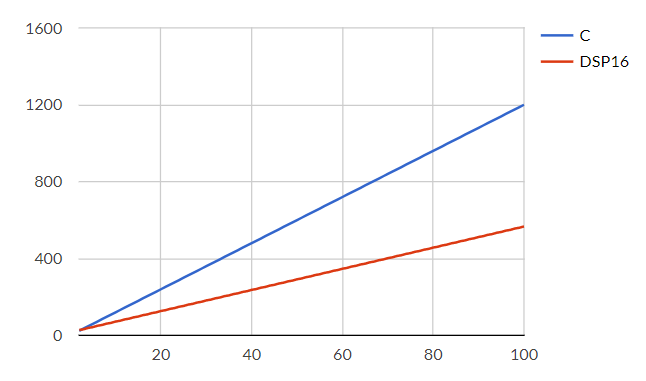
We have clearly enhanced efficiency on all cases (except when sample count is 2!).
In fact, C takes 12 cycles per sample no matter how many samples are treated where DSP implementation starts with 14 cycles per sample and tends to 5,5 for an infinite number of samples (and already under 6 cycles per sample when count > 32).
8-bits DSP implementation
If we make a comparable work on 8-bits data, this leads to a slightly more complex code since we need to unroll loop by 4 and then manage all remaining cases (
Implementation for 8-bits buffers
#include "arm_math.h"

/* Macro to perform post-incrementable 16-bits access */
#define __SIMD16(addr)(*(uint16_t **)&(addr))

#ifdef __ICCARM__
/* IAR is missing BFI (Bit Field Insert) intrinsic and does not automatically generate it where I would like to */
#pragma inline=forced
static inline unsigned long __BFI(unsigned long base, unsigned long src, const unsigned char lsb, const unsigned char width)
{
    unsigned long wRes = base;
    asm("BFI      %0,%1,%2,%3"
                  : "+r"(wRes)
                  : "r"(src), "i"(lsb), "i"(width));
    return wRes;
}
#endif

uint16_t SearchMinMax8_DSP(int8_t* pSrc, int32_t pSize)
{
    uint32_t data, min, max;
    /* max variable will hold four max : one on each byte
     * same thing for min
     */

    /* Load four first samples in one 32-bit access */
    data = *__SIMD32(pSrc)++;
    /* Initialize Min and Max to these first samples */
    min = data;
    max = data;
    /* decrement sample count */
    pSize -= 4;
    /* Loop as long as there remains at least four samples */
    while (pSize >= 4)
    {
        /* Load next four samples in a single access */
        data = *__SIMD32(pSrc)++;
        /* Parallel comparison of max and new samples */
        (void)__SSUB8(max, data);
        /* Select max on each byte */
        max = __SEL(max, data);
        /* Parallel comparison of new samples and min */
        (void)__SSUB8(data, min);
        /* Select min on each byte */
        min = __SEL(min, data);
        /* decrement sample count */
        pSize -= 4;
    }
    /* Now we need to compare bytes in word to extract two max out of four */

    /* look for max between bytes 3 & 1 and 2 & 0 */
    (void)__SSUB8(max, max >> 16);
    /* Select max on bytes 1 & 0 */
    max = __SEL(max, max >> 16);
    /* look for min between bytes 3 & 1 and 2 & 0 */
    (void)__SSUB8(min >> 16, min);
    /* Select min on bytes 1 & 0 */
    min = __SEL(min, min >> 16);

    /* Test if at least 2 samples remain */
    if (pSize >= 2)
    {
        /* Load next two samples in a single access, only bytes 0 & 1 are interesting */
        data = *__SIMD16(pSrc)++;
        /* Parallel comparison of max and new samples */
        (void)__SSUB8(max, data);
        /* Select max on each byte */
        max = __SEL(max, data);
        /* Parallel comparison of new samples and min */
        (void)__SSUB8(data, min);
        /* Select min on each byte */
        min = __SEL(min, data);
        /* decrement sample count */
        pSize -= 2;
    }
    /* Now we need to compare bytes in low halfword to extract one max out of two */
    /* look for max between bytes 1 & 0 */
    (void)__SSUB8(max, max >> 8);
    /* Select max on byte 0 */
    max = __SEL(max, max >> 8);
    /* look for min between bytes 1 & 0 */
    (void)__SSUB8(min >> 8, min);
    /* Select min on byte 0 */
    min = __SEL(min, min >> 8);

    /* Test if at least 1 sample remains */
    if (pSize > 0)
    {
        /* Load last sample */
        data = (uint32_t)*pSrc;
        /* Comparison of max and new sample */
        (void)__SSUB8(max, data);
        /* Select max on byte 0 */
        max = __SEL(max, data);
        /* Comparison of new sample and min */
        (void)__SSUB8(data, min);
        /* Select min on byte 0 */
        min = __SEL(min, data);
    }

    /* Pack result : Min on Byte 0, Max on Byte 1 */
    #ifdef __ICCARM__
        return __BFI(min, (uint8_t)max, 8, 24);
    #else
        return (uint16_t)((uint8_t)min | ((uint16_t)((uint8_t)max) << 8));
    #endif
}
After compilation (with IAR 7.30.4.8187 evaluation compiler), we get:
DSP 8 Optimized compiler output (-Oh)
                               ; Bytes Cycles    Comment
SearchMinMax8_DSP:             ;   -     3       Function call
  PUSH      {r4, r5}           ;   2     3       Backup two registers
  LDR       r3, [r0], #0x4     ;   4     2       Load 4 samples and post-increment
  SUBS      r2, r1, #4         ;   2     1       Decrement loop counter
  CMP       r2, #4             ;   2     1       Test if we need to loop
  MOV       r4, r2             ;   2     1       Copy loaded data to Min register
  MOV       r5, r2             ;   2     1       Copy loaded data to Max register
  BCC       step1              ;   2    1,3      Go through (1 cycle) or loop (3 cycles)
loop:
  LDR       r3, [r0], #0x4     ;   4     2       Load next 4 samples and post-increment
  SSUB8     r1, r5, r3         ;   4     1       Parallel compare Max to new samples
                               ;                 GE[3]=((Max3 - Sample3) >= 0)
                               ;                 GE[2]=((Max2 - Sample2) >= 0)
                               ;                 GE[1]=((Max1 - Sample1) >= 0)
                               ;                 GE[0]=((Max0 - Sample0) >= 0)
  SEL       r5, r5, r3         ;   4     1       Keep max on each byte
  SUBS      r2, r2, #4         ;   2     1       Decrement loop counter
  SSUB8     r1, r3, r4         ;   4     1       Parallel compare new samples to Min
                               ;                 GE[3]=((Sample3 - Min3) >= 0)
                               ;                 GE[2]=((Sample2 - Min2) >= 0)
                               ;                 GE[1]=((Sample1 - Min1) >= 0)
                               ;                 GE[0]=((Sample0 - Min0) >= 0)
  CMP       r2, #4             ;   2     1       Test remaining count
  SEL       r4, r4, r3         ;   4     1       Keep Min on each byte
  BCS       loop               ;   2    3,1      Loop (3 cycles) or go through (1 cycle)
step1:                      ; Compare Byte3 with Byte1 and Byte2 with Byte0
  LSRS      r1, r5, #16        ;   2     1       Put Max3,Max2 on low halfword
  SSUB8     r3, r5, r1         ;   4     1       Parallel compare Max1,Max0 to Max3,Max2
                               ;                 GE[1]=((Max1 - Max3) >= 0)
                               ;                 GE[0]=((Max0 - Max2) >= 0)
  SEL       r1, r5, r1         ;   4     1       Keep max on two lowest bytes
  LSRS      r3, r4, #16        ;   2     1       Put Min3,Min2 on low halfword
  SSUB8     r5, r3, r4         ;   4     1       Parallel compare Min3,Min2 to Min1,Min0
                               ;                 GE[1]=((Min3 - Min1) >= 0)
                               ;                 GE[0]=((Min2 - Min0) >= 0)
  CMP       r2, #2             ;   2     1       Test if remaining sample count is at least 2
  SEL       r4, r4, r3         ;   4     1       Keep min on two lowest bytes
  BCC       step2              ;   2    3,1      Skip (3 cycles) or go through (1 cycle)
  LDRH      r3, [r0], #0x2     ;   4     2       Load two samples and post-increment
  SSUB8     r5, r1, r3         ;   4     1       Compare them to max (only lower 2 bytes)
  SEL       r1, r1, r3         ;   4     1       Keep maximum
  SSUB8     r5, r3, r4         ;   4     1       Compare them to min (only lower 2 bytes)
  SEL       r4, r4, r3         ;   4     1       Keep minimum
  SUBS      r2, r2, #2         ;   2     1       Decrement sample count
step2:                      ; Compare Byte1 with Byte0
  LSRS      r3, r1, #8         ;   2     1       Put Max1 on low byte
  SSUB8     r5, r1, r3         ;   4     1       Compare Max0 to Max1
                               ;                 GE[0]=((Max0 - Max1) >= 0)
  SEL       r5, r1, r3         ;   4     1       Keep maximum on byte 0
  LSRS      r1, r4, #8         ;   2     1       Put Min1 on low byte
  SSUB8     r3, r1, r4         ;   4     1       Compare Min1 to Min0
                               ;                 GE[0]=((Min1 - Min0) >= 0)
  SEL       r1, r4, r1         ;   4     1       Keep minimum on byte 0
  CBZ       r2, pack           ;   2    3,1      Test one sample is remaining and branch on if not
  LDRSB     r3, [r0]           ;   4     2       Load last sample
  SSUB8     r0, r5, r3         ;   4     1       Compare max to new sample
  SEL       r5, r5, r3         ;   4     1       Keep max on byte 0
  SSUB8     r0, r3, r1         ;   4     1       Compare new sample to min
  SEL       r1, r1, r3         ;   4     1       Keep min on byte 0
pack:                       ; Format data to be returned
  UXTB      r5, r5             ;   2     1       Zero-extends 8-bit max to 32-bits
  BFI       r1, r5, #8, #24    ;   4     1       Insert 24 lowest bits of max into 24 highest bits of min
                               ; That puts min on byte0 and max on byte1 (and zeros on bytes 2 & 3)
  POP       {r4, r5}           ;   2     3       Restore two registers
  BX        LR                 ;   2     3       Return


ROM : 140 bytes
Stack : 8 bytes
Cycles : N % 4 = 0 : 13 + 11 * (N/4 - 2) + 36
         N % 4 = 1 : 13 + 11 * (N/4 - 2) + 40
         N % 4 = 2 : 13 + 11 * (N/4 - 2) + 41
         N % 4 = 3 : 13 + 11 * (N/4 - 2) + 45
8-bits comparison
Comparing this output with C :
| Impl. | max ROM | max Stack | Cycle Formula (N multiple of 4) | 8 sps | 100 sps |
|---|---|---|---|---|---|
| C | 40 bytes | 0 bytes | 9 + 12 * (N-2) + 15 | 96 cycles | 1200 cycles |
| DSP8 | 140 bytes | 8 bytes | 13 + 11 * (N/4-2) + 36 | 49 cycles | 302 cycles |
On a range from 4 to 100 samples, following graph shows both C and DSP implementations cycle count.

In 8-bits case, we can expect a division factor of 4 (Damn, this is the number of bytes we can treat in parallel!).
C still takes 12 cycles per sample no matter how many samples are treated where DSP implementation starts with 9,5 cycles per sample and tends to 2,75 for an infinite number of samples (already under 6 cycles per sample when count > 8, under 4 cycles when count > 21).
Going further
You can have a look at previous post which details a bit inlining. But bottom line is: if you have a fixed buffer size, fix the size in code! If you use this routine in a single place, allow your compiler to inline it!
This very same DSP 8-bit implementation now only takes 112 bytes of ROM and 38 cycles to detect min and max over 16 samples (compared to 71 without inlining, and 192 for C routine!).

 ARM Cortex M4 & M7 Unleashed